Manufacturing
How Ruite makes polyurethane wheels in Yantai
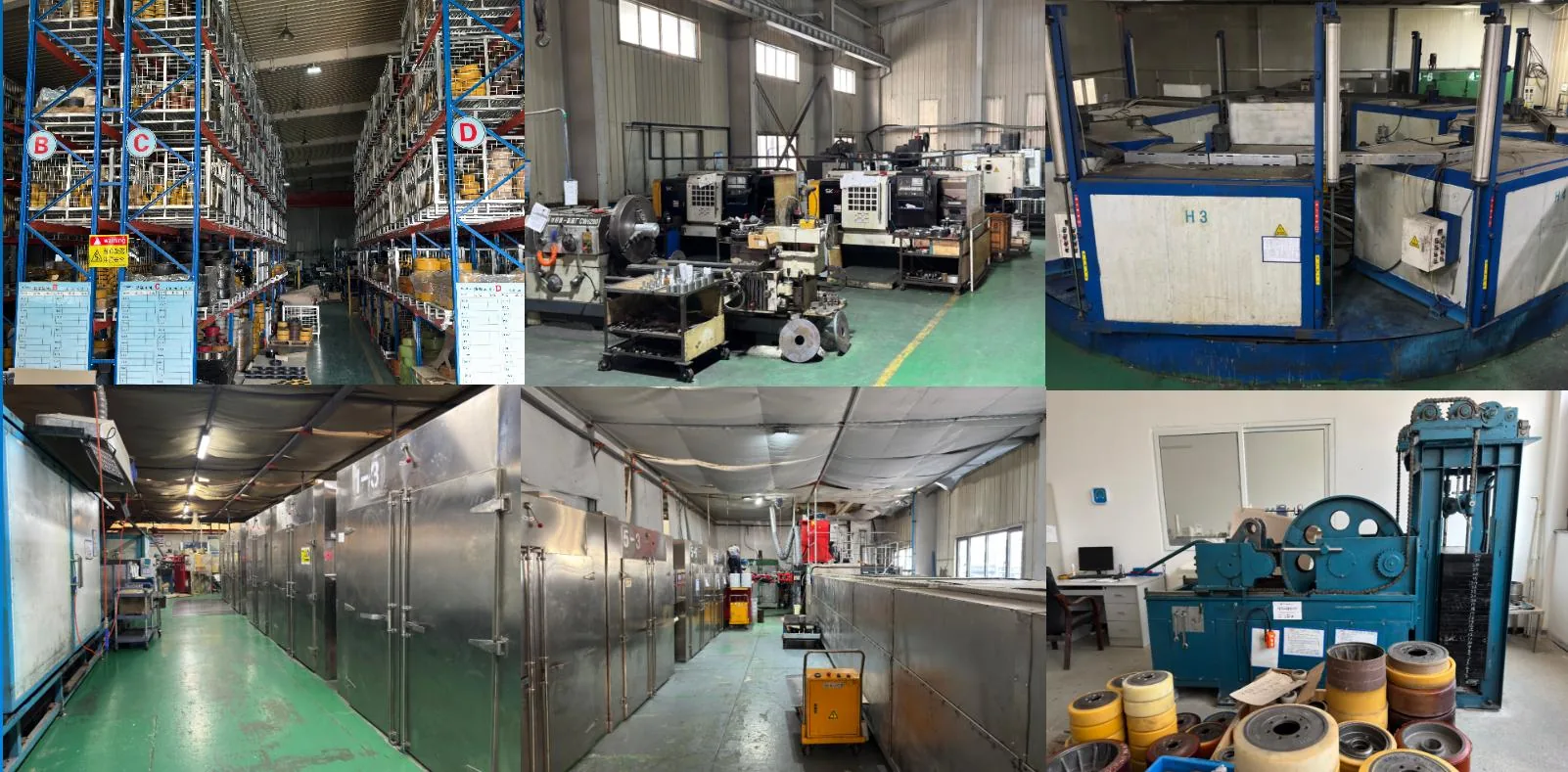
One factory owns the whole path from mould to marked wheel: casting, curing, machining, finishing and inspection, backed by 3,000+ mould sets and 500,000 pieces of annual capacity.
Capacity
Scale at a glance
- Pieces per year
- 500,000
- Mould sets
- 3,000+
- Wheel sizes
- 1,000+
- Built facility
- 10,000 m²
- Site area
- 20,000 m²
Process
From mould to marked wheel
- 01
Mould selection or new tooling
A matching mould is pulled from the 3,000+ set library, or a new mould is made for new sizes and profiles.
- 02
Hub preparation
Metal hubs are machined and surface-prepared, including grit blasting, so the polyurethane can bond.
- 03
Polyurethane casting
The prepolymer and curative are metered on casting machines and poured into the mould around the hub.
- 04
Curing
Wheels cure in vertical ovens and on baking lines. Post-cure sets final hardness and dimensional stability.
- 05
Machining
Lathes and CNC lathes grind and turn tread, profile and bores to tolerance.
- 06
Finishing and marking
Paint line, presses and an engraving machine complete the wheel with your colour, logo or batch code.
- 07
Inspection and packing
Dimensions and hardness are checked before packing. Cleanroom packing is available on request.
Machinery
Equipment in the workshop
| Workshop | Equipment |
|---|---|
| Machining | 10 lathes including 4 CNC, 3 bandsaws, 10 drilling machines |
| Casting and curing | 4 casting machines, 2 baking lines, 20 vertical ovens |
| Finishing, marking and testing | Paint line, grit blaster, presses, engraving machine |
| Mould warehouse and tooling | Structured storage for 3,000+ mould sets covering 1,000+ sizes |
Materials
Raw materials and polyurethane systems
We combine imported premium raw materials with high-grade local supply, balancing performance stability and cost.
| System | Series / type | Characteristics |
|---|---|---|
| Polyurethane (PU) | TDI, MDI and NDI series; high-performance prepolymers and curatives | High load capacity, tear resistance, low heat build-up |
| Natural rubber (NR) | For heavy-duty, high-traction tires | Elasticity, shock absorption, grip |

Which system when? TDI for cost-driven general duty, MDI for dynamic load and humid areas (with polyether base), NDI for high load, high speed and low heat build-up. We confirm the choice on the selector result and in engineering review.